
Chemin de fer de la Combe by mountain bike
Bayons Easy
Easy
Chemin de fer de la Combe by mountain bike
Easy1h30
10,8km
+304m
-304m
Loop
Embed this item to access it offline
Follow the Mountain Bike Trail No. 11 (VTT N°11)
Description
- Walk through the village of Bayons (875 m) toward Turriers until you reach the intersection with Route D 1 (1 km).
- Cross Route D 1 by taking the small paved road directly across from it. Follow it for 500 m; it turns into a dirt track. Follow it to the ford.
- At the Soubeyrache ford (900 m), take the trail on the left that heads into the upper Sasse Valley for 3.2 km.
- On the Combe trail (1010 m), take the trail on the right that crosses the Sasse toward the “Grande Cabane” for 1.5 km.
- At the trail junction (1,032 m), leave the “Grande Cabane” trail to your left and continue to the right. A section through black soil and a rocky descent along the old railroad tracks leads to the new bridge over the Sasse and the ascending trail. Then follow the directions in reverse to return to the starting point.
- Departure : Village, Bayons
- Arrival : Village, Bayons
- Towns crossed : Bayons
Forecast
Altimetric profile
Recommandations
- Bike service station (bike wash, air pump, water fountain) in Clamensane (in front of City Hall).
- Caution: there is a tricky section near the stream next to the Combe trail.
Information desks
Transport
Let’s limit our trips and use public transportation and carpooling: https://zou.maregionsud.fr
Access and parking
From Sisteron (30 km), take the D 951, then the D 1 toward Bayons.
Parking :
Parking lot in Bayons
1 point of interest
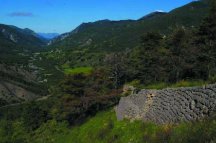
Mur de soutènement - Office de Tourisme La Motte du Caire  History
La Combe Railroad
No, you’re not dreaming—a railroad track was actually built in the 1920s in this remote corner of the Provençal highlands. Back then, wood was used to shore up mine tunnels, erect telegraph poles, and make railroad ties. As a result, in this valley of La Combe, nestled between the headwaters of the Sasse River and the village of Bayons, a railway transported the timber harvested from its slopes. A small steam train handled the transport all the way down to the village, taking over from a cable car that served the valley floor, near the hamlet of La Combe. This hard labor was carried out mainly by Piedmontese lumberjacks and charcoal burners. It was certainly a difficult trade, but also a dangerous one, as some in the village recall or heard in their youth that, when this train first began operating, one of them perished under its wheels. Today, there are no more railcars, no more screeching brakes or wheels on the tracks, but a few walls or rusted remnants from that era (especially after crossing the Sasse and heading up the GR 6 near the ruins of L’Adret) remind us of this human adventure from the last century.
More information


Report a problem or an error
If you have found an error on this page or if you have noticed any problems during your hike, please report them to us here: